Full-day workshop

From Capability
to Assurance: Trustworthy Humanoid Systems
in Human Environments

Date
Location
Santa Clara, California
Human environments. Trustworthy systems.
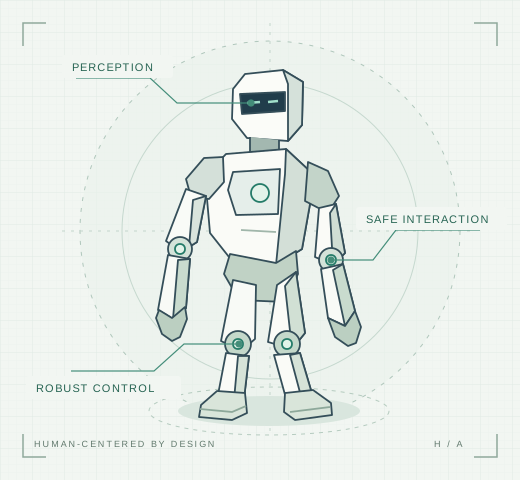
A humanoid robot within an assurance boundary, with callouts for perception, safe interaction, and robust control.
CapabilityEvidenceAssurance

Assurance across the humanoid system.

Humanoid safety requires more than safe AI models or safe robot control considered in isolation. Learning-enabled humanoids connect perception, reasoning, planning, whole-body action, physical interaction, runtime supervision, and recovery.

Errors or uncertainty at one layer can propagate into unsafe contact, balance loss, object dropping, or inappropriate whole-body actions around people. This workshop examines how safeguards work across these layers and what evidence can demonstrate their effectiveness under uncertainty and failure.

Central technical questions

How can humanoids perceive, reason, plan, act, and recover safely under uncertainty and failure, and how do we evaluate those safeguards?

What evidence is sufficient to trust a learning-enabled humanoid operating physically around people?

02 Topics of interest

The foundations of assurance.

01

Safety-aware planning & control

Linking reasoning and task plans to whole-body constraints, balance, and contact-aware action.

02

Verification, validation & assurance

Testing assumptions across learned components, controllers, and runtime safeguards; building system-level evidence.

03

Human–humanoid interaction

Safe contact, object handling, and predictable whole-body behavior around people.

04

Runtime supervision & recovery

Detecting uncertainty and failures, supervising learned actions, and recovering from unsafe states.

05

Benchmarks & evaluation

Evaluating error propagation, physical consequences, and safeguard effectiveness in simulation and real-world tests.

06

Responsible deployment

Defining operational boundaries and connecting monitoring and incident evidence to lifecycle assurance.

03 Contribute to the workshop

Call for Papers & Demos

We invite papers and demos addressing safety and assurance for humanoid systems operating in human environments.

We welcome two types of paper submissions:

Short / Position Papers — up to 4 pages

Early-stage research, position papers, preliminary results, failure analyses, benchmark proposals, safety architectures, and emerging research directions.

Research Papers — 4–8 pages recommended

Substantially developed research contributions, including methods, system studies, experiments, benchmarks, and safety evaluation studies.

Paper submission information

QR code for the OpenReview paper and demo submission portal
Scan to open OpenReview
Format
Paper submissions should use the IEEE standard double-column conference format. One additional page may be used exclusively for references. Appendices are not considered as part of the review submission.
Review process
Papers will undergo single-blind review. Authors do not need to anonymize their submissions. Review notifications will be sent out on a rolling basis from November 2 to November 20. Papers will be reviewed as submissions are received, and we will make every effort to notify authors of the review results as early as possible.
Presentation
Accepted papers will be presented as posters. Selected papers will additionally be invited for short spotlight presentations.
Publication policy
No formal proceedings (we are a non-archival workshop). Authors are welcome to post their papers on arXiv.

Call for Demos

Demo Submit!

Demo submissions are now open! The deadline is November 15, 2026 (23:59 AoE). Paper and demo submissions use the same OpenReview portal.

We welcome demos using simulation, portable equipment, or physical robots.

File format
Any file format is accepted.
Title / heading
The title or heading of your submitted document must clearly include the word Demo.
Demo materials
Include a demo video or animation and a brief description of the demo's functionality. Clearly state whether the demo uses simulation, portable equipment, or a physical robot.
Equipment
Applicants are generally expected to bring their own demo equipment. Please specify any additional requirements in your submission.
Presentation arrangements
Details of the demo presentation format, schedule, and on-site setup arrangements will be announced.
Special arrangements & questions
If you have any special requests, questions, or need additional arrangements, please feel free to contact us directly via email.

04 Speakers

Invited Speakers

Kuan Fang

Kuan Fang

Cornell University

Bio

Yan Gu

Yan Gu

Purdue University

Bio

Guoquan (Paul) Huang

Guoquan (Paul) Huang

University of Delaware

Bio

Marco Pavone

Marco Pavone

Stanford University / NVIDIA

Bio

05 Organizing committee

Organizers

Chuchu Chen

Chuchu Chen

Assistant Professor

George Washington University
Georgios Fainekos

Georgios Fainekos

Senior Principal Scientist

Toyota Motor North America

Abhijeet Kulkarni

Abhijeet Kulkarni

Ph.D. Candidate

University of Delaware
Hideki Okamoto

Hideki Okamoto

Senior Principal Engineer

Toyota Motor North America
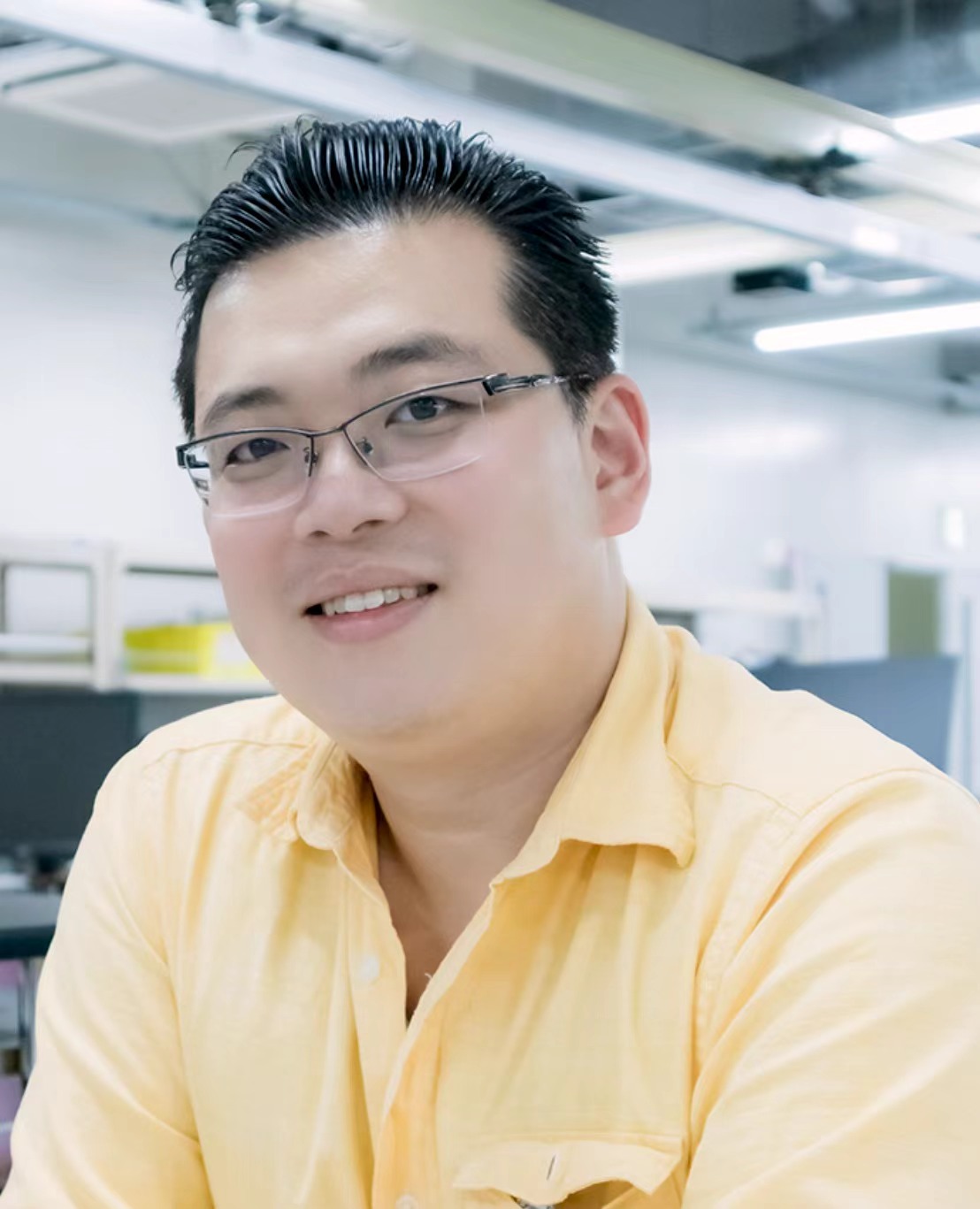
Zijun Sha

Zijun Sha

Research Engineer

Toyota Motor Corporation

06 Get in touch

Contact

For questions about contributions, participation, special demo requests, or additional arrangements, please feel free to contact us directly via email.
Workshop contact Zijun Sha zijun_sha@mail.toyota.co.jp

Toyota Motor Corporation